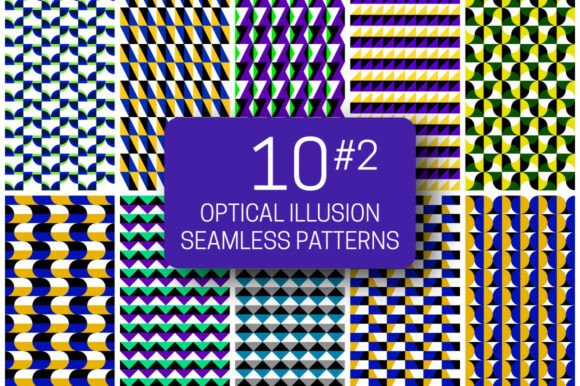
10 Optical Illusion Patterns Pack 2
In the world of visual design, capturing attention is only half the battle. The second half is holding it. When viewers encounter a design that seems to shift, pulse, or move before their eyes, they pause. This phenomenon, known as an optical illusion, leverages the brain’s tendency to fill in gaps and interpret patterns in specific ways. For designers, marketers, and creative professionals, these effects are not just party tricks; they are powerful tools for engagement. 10 Optical Illusion Patterns Pack 2 offers a curated collection of these mesmerizing textures, designed to add depth and intrigue to digital and print projects without requiring complex coding or heavy rendering times.
This sequel expands on the success of its predecessor by introducing ten new seamless patterns that are both mathematically precise and artistically compelling. Whether you are building a brand identity, designing a website background, or creating social media assets, these files provide an immediate upgrade to your visual vocabulary. The pack is built for flexibility, ensuring that whether you are working on a mobile interface or a large-format billboard, the quality remains uncompromised.
Why Seamless Patterns Matter in Modern Design
Before diving into the specifics of this pack, it is essential to understand why seamless patterns remain a staple in professional design workflows. Unlike raster images that tile with visible seams, seamless patterns repeat infinitely without interruption. This makes them ideal for backgrounds, textures, and overlays where continuity is key. They allow designers to create immersive environments that feel expansive rather than repetitive.
The challenge with many pre-made pattern libraries is rigidity. Often, changing the color palette or scale requires significant manual effort. 10 Optical Illusion Patterns Pack 2 addresses this by providing vector-based sources. This means you can manipulate the underlying geometry, adjust colors to match your brand guidelines, and resize elements without losing sharpness. It bridges the gap between static stock assets and fully custom illustrations.
Technical Advantages: Vector Precision Meets Artistic Depth
One of the most critical features of this collection is its file format. All ten patterns are delivered as EPS 10 files, which are fully editable in Adobe Illustrator and compatible with Photoshop. This vector foundation ensures that every line, curve, and intersection is defined by mathematical coordinates rather than pixels. The benefits of this approach are substantial:
- Infinite Scalability: You can scale a pattern from the size of a favicon to the width of a skyscraper wall without any loss in resolution. There is no pixelation, blurring, or jagged edges.
- Editability: Need to change the hue of the primary shape? Simply select the path and apply a new color. Want to adjust the spacing between the illusionary elements? Use the transform tools to stretch or compress the geometry.
- Small File Sizes: Compared to high-resolution raster images, vector files are lightweight. This is crucial for web performance, ensuring that your designs load quickly even when used as full-screen backgrounds.
For users who prefer working in Photoshop, these EPS files can be placed as smart objects. This allows you to non-destructively edit the pattern within your raster workflow, combining the precision of vectors with the texturing capabilities of Photoshop filters and blending modes.
Creative Applications Across Industries
The versatility of optical illusions lies in their ability to evoke different emotions depending on context. Here is how various professionals can leverage 10 Optical Illusion Patterns Pack 2 for distinct outcomes.
Digital Product Design
UI/UX designers often struggle with making interfaces feel engaging without cluttering the screen. Subtle optical patterns can serve as excellent backdrops for dashboards, landing pages, or app onboarding screens. Because these patterns are seamless, they can cover entire viewports while keeping the foreground content readable. Try using a low-opacity version of one of the patterns behind a solid-colored card element to add texture and depth. This technique, known as "texture overlay," prevents flat white spaces from feeling sterile.
Brand Identity and Packaging
For entrepreneurs and small business owners, standing out on the shelf or in a crowded feed is vital. Optical illusions naturally draw the eye due to their inherent movement. Using these patterns on product packaging, business cards, or logo watermarks can signal innovation and creativity. Imagine a tech startup using a geometric, shifting pattern on their business cards. The tactile experience of looking at the card becomes memorable because the eye cannot rest immediately.
Social Media and Content Marketing
Bloggers and content creators can use these patterns to break up long-form text or to create visually striking headers. Instead of generic gradient backgrounds, a subtle optical pattern can give a blog post a premium feel. In social media graphics, these patterns work exceptionally well for stories and reels covers. By animating the pattern slightly—using simple CSS keyframes or GIF loops—you can create dynamic thumbnails that encourage clicks.
Practical Tips for Implementation
To get the most out of 10 Optical Illusion Patterns Pack 2, consider the following practical advice to ensure your designs remain effective and audience-friendly.
- Maintain Contrast: Optical illusions rely on contrast to work. If your background is dark, use light pattern lines, and vice versa. Ensure that the pattern does not compete with your primary message. Text should always have sufficient contrast against the patterned background.
- Control Opacity: One of the easiest ways to integrate these patterns is by reducing their opacity. A pattern at 5-10% opacity can add texture without overwhelming the viewer. Experiment with blend modes like "Overlay" or "Soft Light" in Photoshop to see how the pattern interacts with underlying colors.
- Consider Accessibility: While optical illusions are captivating, they can be disorienting for some users, particularly those with vestibular disorders or sensitivity to flashing lights. Avoid using highly contrasting, rapidly moving patterns in auto-playing video content. Static patterns are generally safe, but always test your design with diverse audiences.
- Iterate and Customize: Do not use the patterns exactly as provided if you want a truly unique result. Tweak the colors to align with your brand palette. Rotate the pattern by 45 degrees to change its dynamic flow. Combine two different patterns from the pack to create a hybrid effect.
Expanding Your Creative Toolkit
The value of 10 Optical Illusion Patterns Pack 2 extends beyond the immediate visual impact. It serves as a learning resource for designers interested in generative art and geometric composition. By studying how the patterns are constructed in Illustrator, you can learn techniques for creating your own seamless repeats. Understanding the interplay of positive and negative space in these illusions can improve your overall sense of balance and rhythm in design.
Furthermore, these patterns are timeless. Trends in graphic design come and go, but the human fascination with visual paradoxes is constant. Investing in a library of high-quality, editable optical illusions is a long-term strategy for maintaining a fresh and intriguing aesthetic. Whether you are refreshing an old portfolio or launching a new venture, these patterns offer a sophisticated shortcut to high-end visual appeal.
In conclusion, 10 Optical Illusion Patterns Pack 2 is more than just a set of textures; it is a catalyst for creativity. It empowers designers to create hypnotic, engaging, and professional-grade visuals with minimal friction. By leveraging the power of vector scalability and artistic depth, you can captivate your audience and let your designs do the talking. Explore the possibilities, customize the patterns to fit your vision, and watch your projects come alive with motion and mystery.